
A caddie never swings the club, but the best players in the world won’t hit a shot without hearing from one. Head coaches make hundreds of decisions under far more pressure, with nobody beside them whose only job is to ask, “Are you sure that’s the right club?”
Every professional golfer has someone who knows the yardage, reads the wind and knows his player’s tendencies, and who will talk him out of a hero shot. The player still decides. Football and hockey teams spend hundreds of millions on players and coaches, yet the person making the biggest calls on game day usually works without that check.
What a caddie actually does
Anyone who plays seriously knows a good caddie does four things, and none of them is hitting the ball.
- He knows the numbers. Yardage to the front, the middle and the back, and where the trouble is.
- He reads the conditions. Wind, lie, firmness, and how the course is playing today, not how it played in the practice round.
- He knows his player. How far he’s really hitting it today, his tendencies under pressure, and when adrenaline is about to make him fly the green.
- He talks him off the hero shot. When the player reaches for the club that wins the highlight reel, the caddie asks one question: what happens if you miss?
Then he hands over the club the player chose. The decision and the accountability stay with the player. The caddie’s value is that someone with no ego in the swing looked at the shot first.
The coaching blind spot
Coaches don’t lack information. They lack someone outside the play-calling who is paid to question them in the moment. Two examples from this week show what that costs.
Sunday at Gillette. The Patriots’ two second-quarter touchdown drives were quick and fluid. The ball came out on time to backs and slot receivers, and the run game averaged almost 6 yards a carry. Then the offense went back to waiting on deep shots behind a patched-up line, and Drake Maye threw three interceptions. With about 1:45 left in the half near midfield, down 10, the Patriots went three-and-out. Green Bay scored on the first drive of the second half, and the game was gone.
A caddie on that headset asks two questions. Why did we stop doing what worked? And what’s our plan for these last 1:45, with points to gain and a lead to cut before Green Bay gets the ball back?
The Rangers’ crease. When Igor Shesterkin’s knee ended his season in October, the Rangers priced Connor Hellebuyck on a healthy Shesterkin and a cap sheet, and passed. The Devils got him. A caddie asks the question nobody asked: what if Shesterkin, with three lower-body injuries in three seasons, isn’t the same next fall?
Neither question needs a genius. Each needs someone whose job is to ask it before the shot, not after.
What a coach’s caddie looks like
The job is simple to describe and hard to fill: an independent voice on the head coach’s channel whose only loyalty is to the decision.
The rules
- No play-calling authority. The caddie recommends; the coach decides. That’s what keeps the coordinators from treating him as a threat.
- Outside the system. He’s not the offensive coordinator’s protégé or the GM’s ally. A caddie who owes his job to the play-caller won’t challenge the play-caller.
- A short list of questions, asked every time. What’s working that we’ve stopped doing? What does this situation call for on the clock? What happens if this goes wrong?
- Same voice before, during and after. He helps build the situational plan on Thursday, asks the questions on Sunday, and grades the calls on Monday.
The tools
Ten years ago this took a staff of analysts. Today one sharp person with AI can track in real time what each drive did, flag when the game plan has drifted from what’s working, and run the clock and fourth-down math before the coach has to ask. Building models isn’t the hard part anymore. The scarce skill is asking the right question at the right moment and having the standing to ask it.
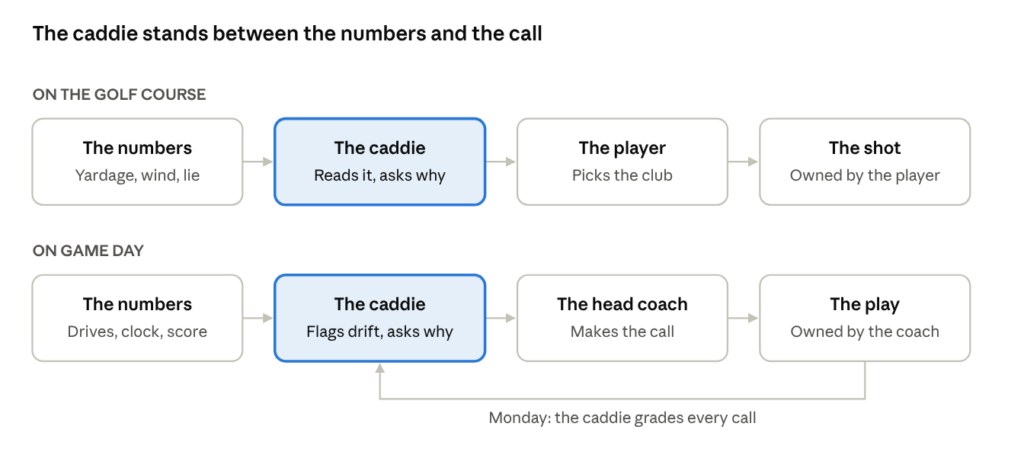
The caddie’s seat in golf and on game day
The caddie sits in the same seat in both sports: after the numbers, before the decision, and never in place of the person who owns it.
Some teams are halfway there
The idea isn’t far-fetched. Part of it already exists. Several NFL teams have a game-management coach on the headset for fourth downs, two-point tries, timeouts and challenges. Ryan Paganetti did that job for Doug Pederson and Pete Carroll for years, and the Jets credited Dan Shamash with the same work under Robert Saleh.
Those roles stop at the math of single moments. The caddie goes one step further and questions the plan itself: whether the game has drifted from what works, and whether the decision in front of the coach fits the conditions he actually has.
Hockey has proof the outsider’s eye pays off. Carolina’s general manager, Eric Tulsky, and his assistant GM, Tyler Dellow, both came up as analytics bloggers. Their team won the Stanley Cup in June and leads the East again.
The best golfers in the world wouldn’t play a round without a caddie. The people making million-dollar calls on game day shouldn’t either.
