With no top-end free agents in this year’s NHL unrestricted free agent class, many expected free agency and the offseason to be relatively quiet. Thankfully for hockey fans, it has been one of the wildest offseasons in recent memory.
The reason? Restricted free agents.
This year’s RFA class has been loaded, headlined by Connor Bedard, Jason Robertson, Leo Carlsson and Pavel Mintyukov. While Carlsson and Mintyukov have already signed new deals, we’ll discuss those later. First, let’s examine the remaining unsigned RFAs and compare their situations to determine what could be next.
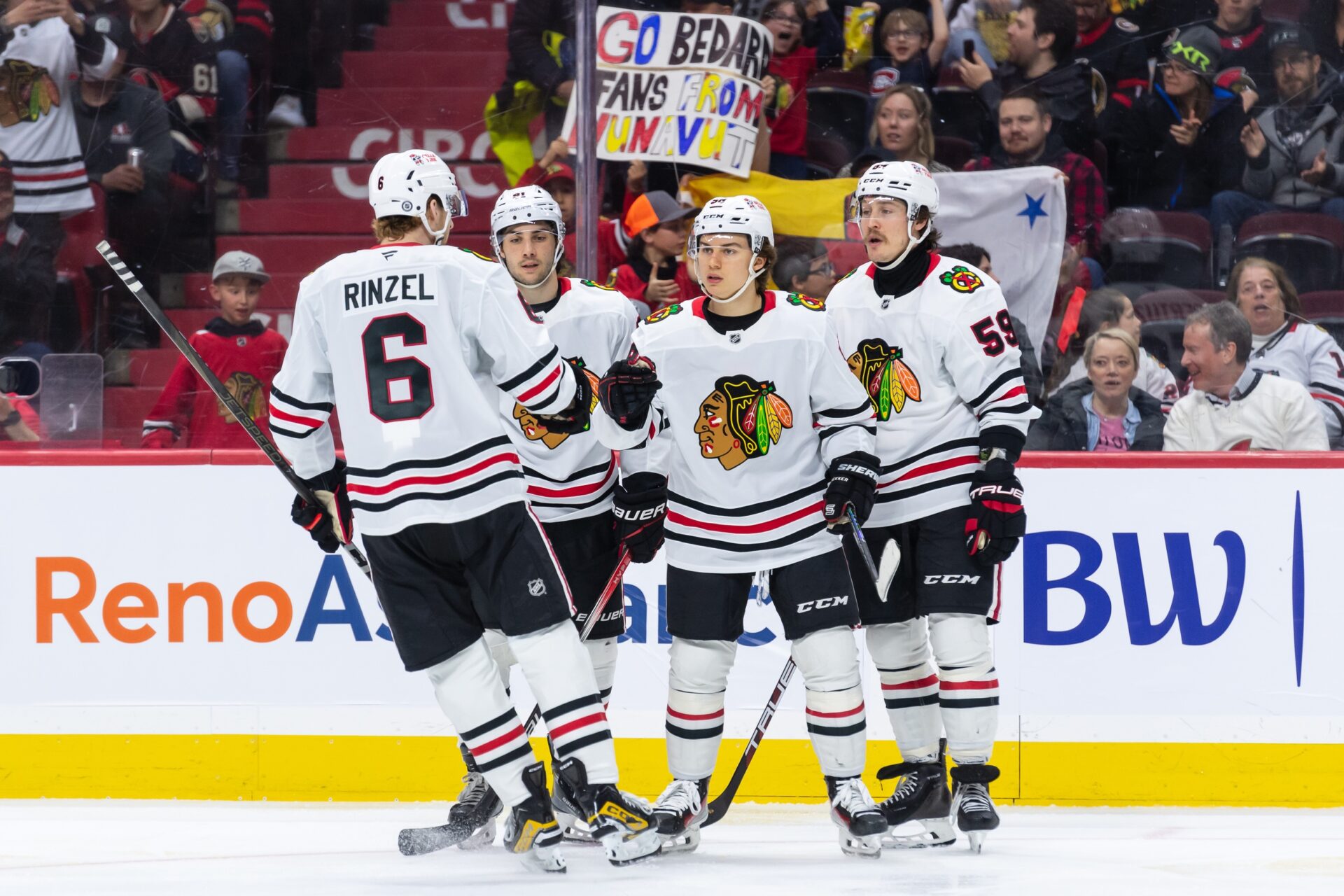
Connor Bedard, C, Chicago Blackhawks
Connor Bedard is coming off the best season of his NHL career, which couldn’t have come at a better time entering restricted free agency. He averaged more than a point per game for the first time, finishing with 75 points in just 69 games after missing 12 contests with a right shoulder injury.
Even with the missed time, 30 goals and 75 points as a 20-year-old is an impressive accomplishment as Bedard continues to develop into one of the league’s premier stars. An improved blue line, led by Bowen Byram, should only help increase his production, particularly on the power play.
Recently, a video circulated on social media showing Bedard losing an edge during practice and crashing into the end boards. The fall reportedly resulted in another shoulder injury that is expected to sideline him for approximately four months. If accurate, the injury could impact his contract negotiations and expected cap hit. His current timetable has him returning in November, and hopefully there are no additional setbacks. The emergence of Bedard and Macklin Celebrini was one of last season’s best storylines, and hockey is better when both are healthy.
Chicago’s forward group remains relatively thin, which could work both ways. Bedard should continue to receive every offensive opportunity available, but expectations may need to be tempered if he experiences a slower start after returning from injury.
Currently, Bedard is producing at roughly a 1.08 points-per-game pace, which rounds to about 1.1. That projects to roughly 90-95 points over a full season. If Chicago signs him to a longer-term contract, the organization is likely projecting him as a future 100-120 point player.
Comparable players include Macklin Celebrini (115 points), Mark Scheifele (103) and Nick Suzuki (101). Celebrini remains on his entry-level contract, making his $975,000 salary an unfair comparison. Scheifele earns $8.5 million annually, but he signed that contract at age 30 and is now 33 years old. Suzuki signed an eight-year extension at age 21 with an average annual value of $7.875 million and is now in Year 5.
Each situation is different. Winnipeg relies heavily on Kyle Connor as its primary goal scorer, while Bedard is unquestionably the centerpiece of Chicago’s rebuild. Because of his age, production and overall importance to the franchise, I believe Bedard deserves more.
My expectation is somewhere around $11-12 million annually on a one- or two-year bridge deal. A contract of five years or fewer could reach as high as $16 million annually, while anything longer probably tops out around $18 million. However, after two shoulder injuries, I don’t believe Chicago will go that high until Bedard proves he can stay healthy and replicate this level of production.
My prediction is a two-year contract worth $12 million annually, though I could see negotiations pushing that figure closer to $14 million because of how pivotal he is to the Blackhawks’ future.
Jason Robertson, LW, Dallas Stars
It has already been reported that Jason Robertson turned down a contract reportedly worth $15 million annually from Seattle. Whether that reflects concerns about Seattle’s long-term outlook or the new tax implications for higher earners is difficult to say. States such as Texas, Florida and Nevada remain attractive because they do not have a state income tax, and Robertson could likely command similar money from clubs such as Dallas, Tampa Bay, Florida or Vegas if the salary cap were not a factor.
Robertson has never built his reputation around defensive play, but he and Wyatt Johnston each scoring 45 goals last season shows exactly how valuable he is to Dallas. Remove more than 40 goals from any lineup, and that team is almost certainly taking a step backward.
The 26-year-old is coming off a 96-point season with 51 assists. While he isn’t known as a playmaker, he remains one of the NHL’s elite finishers. Although he didn’t match his career-high 109-point campaign from 2022-23, this season reinforced just how special he is.
It surprised many that Robertson reportedly declined $15 million annually, but when you consider he tied Kirill Kaprizov in goals and Kaprizov now carries a reported $17 million average annual value, it’s easier to understand Robertson’s position. Robertson likely believes he’s worth at least that amount. He also finished tied with Macklin Celebrini in goals, further strengthening his case. With Leo Carlsson signing an $18 million offer sheet, Robertson has every reason to believe his value starts in that neighborhood.
When Tyler Seguin eventually moves to long-term injured reserve, Dallas is projected to have approximately $19.85 million in cap space. Because Robertson can now only sign a one-year contract through arbitration, I believe an arbitrator could award him at least $19 million, and perhaps even $19.5 million.
I don’t expect an arbitrator to hand him the maximum possible award, but if I were Robertson’s representative, I’d absolutely point to comparable deals and argue that a player producing nearly a point per game with more than 45 goals deserves to be among the league’s highest-paid forwards.
Leo Carlsson, C, Anaheim Ducks
Well, that didn’t take long.
Thanks to Philadelphia Flyers general manager Daniel Brière tendering a five-year, $90 million offer sheet worth $18 million annually, Carlsson secured one of the richest contracts ever signed by a young player.
For comparison, Connor McDavid signed his first contract after his entry-level deal for eight years and $100 million, carrying a $12.5 million average annual value. Carlsson will nearly match McDavid’s total earnings from that contract in almost half the time.
It’s safe to say Carlsson’s face probably lit up when that offer sheet arrived.
I also saw a graphic circulating on social media showing Carlsson is scheduled to earn $39 million over the next two seasons, which is $4 million more in actual salary than Connor McDavid, Auston Matthews and Nikita Kucherov earned over the same period in their first major contracts. That’s remarkable.
Carlsson finished with 67 points in 70 games at age 21, falling just short of a point-per-game pace. I expect him to surpass that mark this season or next, and by Year 3 this contract could look like a bargain. While it appears expensive today, it could ultimately prove to be a terrific deal for Ducks general manager Pat Verbeek.
The downside is that it limited Anaheim’s flexibility. Losing an aging Jacob Trouba hurts, but delaying Carlsson’s contract negotiations for several years may have created additional challenges. With Lukas Dostal struggling late last season, the Ducks still have important financial decisions ahead before opening night.
Pavel Mintyukov, D, Anaheim Ducks
Pavel Mintyukov signed a five-year contract worth $7.2 million annually.
Rumors surfaced that his agent was hoping another team would submit an offer sheet to increase Anaheim’s leverage during negotiations. Personally, I don’t think that ever became a realistic possibility.
Outside of perhaps Los Angeles or San Jose, I don’t believe many teams had enough interest to surrender a first-round and third-round pick in compensation. That’s a steep price for a left-shot defenseman, especially considering left-handed defensemen are generally more plentiful than right-handed ones.
That said, Anaheim had already lost two defensemen and couldn’t afford to lose Mintyukov through an offer sheet or arbitration. I think it’s a fair contract for a player the Ducks hope eventually becomes their No. 1 defenseman.
My biggest concern remains durability. He has yet to play a full NHL season, and once you’re paying more than $7 million annually, reliability becomes just as important as talent. Hopefully, for Anaheim’s sake, he proves he can stay healthy.
Is the Offseason Finally Cooling Down?
I think so.
Patrick Kane was expected to sign with either Chicago or Detroit by now, yet he remains unsigned. Like many NHL insiders have suggested, I think most executives are settling into their summer break and major news won’t resume until August.
That said, if teams Connor Hellebuyck is interested in begin exploring trade possibilities now that most major business has wrapped up, we could still see movement over the coming days. I believe there’s more urgency surrounding Hellebuyck than Kane because I don’t think Hellebuyck can realistically return to Winnipeg after everything that has become public.
Of course, we’ve all learned to expect the unexpected during this offseason.
For now, though, it finally feels like the calm before the next wave of news. Don’t worry—we’ll still have plenty to discuss.
Check out the latest articles from EasySportz
Check out the latest FIFA World Cup scores