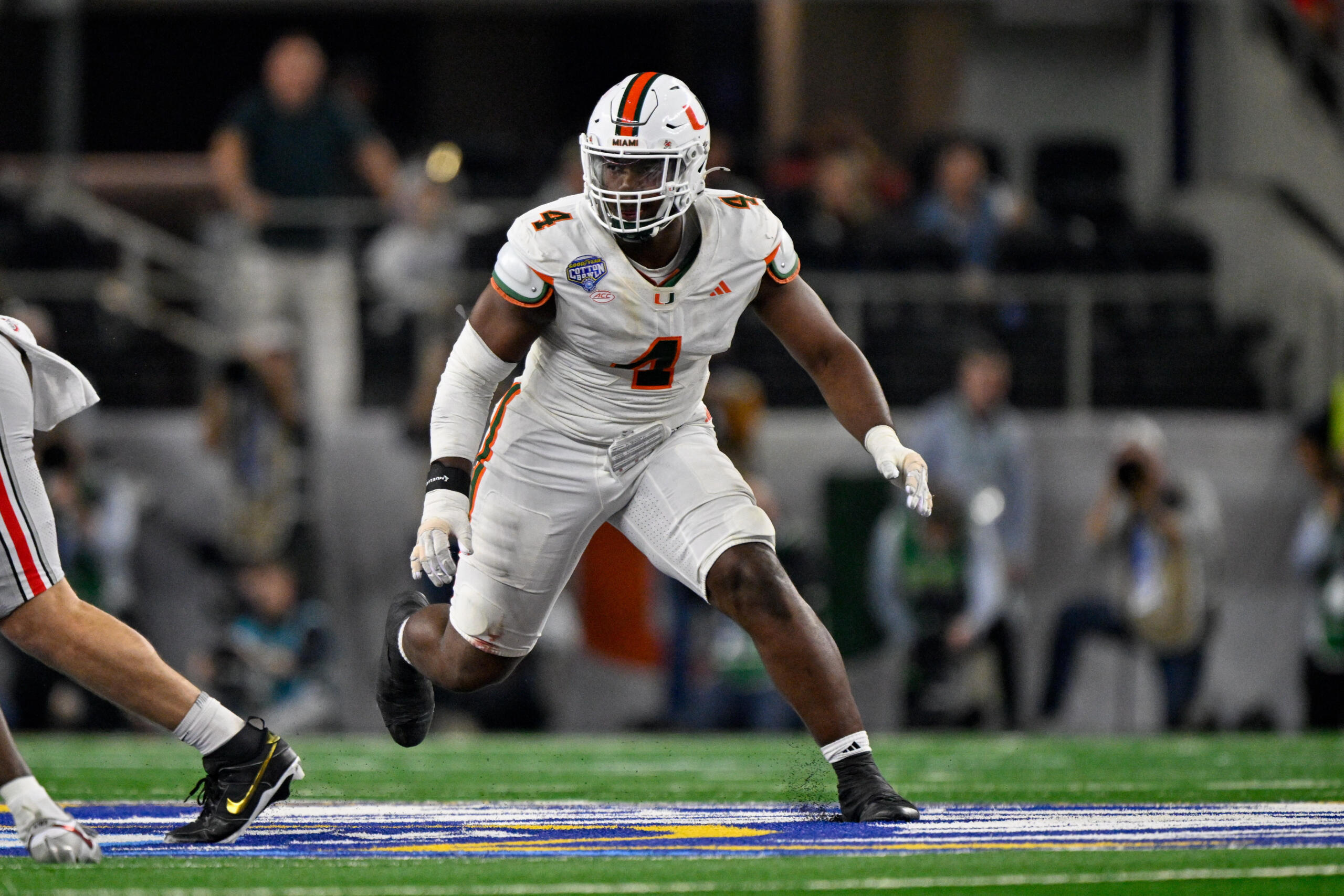
Rueben Bain Jr. does not need a complicated explanation.
The Miami edge rusher looks the part, plays the part and produces the kind of tape that usually makes NFL evaluators comfortable rather than conflicted. Yet as draft season stretches on and boards get picked apart, Bain risks becoming the type of prospect decision-makers talk themselves out of instead of leaning into what is already clear.
Statistically, Bain’s production mirrors his impact on the field, and those numbers are still climbing. Through Miami’s ongoing season, he has totaled 45 tackles, 13 tackles for loss and 8.5 sacks, along with a forced fumble and an interception. Those figures already place him among the ACC’s most disruptive defenders, with additional games still ahead. Over the course of his career at Miami, Bain has pushed toward 20 sacks and more than 100 total tackles, showing steady backfield production that continues to grow as the season progresses.
Bain is built like an NFL defensive end. He carries his weight well, plays with functional strength and shows the balance to stay upright through contact. From the first snap, his physical presence shows up. Tackles feel him in the run game. Quarterbacks feel him when they step up. Tight ends rarely slow him down when asked to block one-on-one.
His game starts with power, but it does not end there. Bain consistently plays with good pad level and leverage, allowing him to convert speed to power and collapse the edge. When he wins early with his hands, the rep is usually over. His punch is violent and well-timed, and he understands how to work half a man instead of getting stuck head up. That ability shows up against both pass and run, where he sets a firm edge and forces ball carriers to bounce wider than they want.
What separates Bain from many college edge rushers is how comfortable he looks doing the basics snap after snap. He does not freelance himself out of position. He reads blocking schemes quickly and reacts with purpose. When teams try to down block him or pull away, he squeezes the gap and keeps his shoulders square. When the ball comes his direction, he finishes.
As a pass rusher, Bain may not be the flashiest player in the class, but his efficiency stands out. He gets pressure without needing to be schemed free. He understands angles, uses his hands well and rarely wastes movement. His rush plan is clear. He attacks the outside shoulder, counters inside when linemen overset and keeps driving his feet through contact. He does not rely on one move or hope for a clean win. He works.
That approach makes him a natural fit for multiple defensive fronts. Bain can line up as a traditional 4-3 defensive end or stand up and rush in hybrid looks. More importantly, he has the strength and core power to reduce inside on passing downs and hold up against guards. His lower-body strength allows him to anchor when double-teamed, and his hand usage gives him a chance to win quickly in tighter spaces. That inside-outside flexibility increases his value in sub-packages, where defensive coordinators look to create favorable matchups without substituting.
The temptation for scouts and general managers will be to nitpick. One area likely to draw attention is his arm length, which does not fit the ideal threshold some teams prefer at the position. In isolation, that measurement may spark debate. On tape, it simply has not mattered. Bain consistently creates extension with timing, hand placement and leverage. He wins the chest of blockers, controls reps early and rarely gets locked out. His ability to play with bend and strength mitigates any theoretical disadvantage.
Arm length matters when a player struggles to disengage or finish. Bain does neither. He sheds blocks, affects passing lanes and closes space with urgency. Overemphasizing measurements at the expense of functional play risks missing the forest for the trees. NFL linemen win with technique and power as often as reach, and Bain has shown he can survive and thrive without ideal dimensions.
There will also be questions about whether he has elite bend or rare first-step burst. Those are fair discussions. They are also secondary. Bain’s floor is high because his game is built on traits that translate immediately to Sundays: strength, awareness, effort and repeatable execution.
He plays with consistent energy. He chases from the backside. He finishes tackles. He does not disappear for long stretches. Coaches value that reliability, especially on the defensive line, where effort and discipline often determine playing time early in a career.
Bain also shows maturity in how he handles traffic. He keeps his eyes up, recognizes screens and does not overrun plays. Those details matter for rookies expected to contribute in rotational roles before becoming full-time starters. Mistake-free football earns trust quickly.
In a league that often chases the next outlier athlete, Bain represents the value of trusting clean evaluation. He checks the physical and production boxes that matter and plays with an NFL mindset. There is no mystery here. No projection that requires blind faith.
Teams that stay disciplined on their board will see Bain for what he is: a dependable edge defender with starting ability and the versatility to impact games from multiple alignments. Arm length and other marginal concerns should not obscure the larger picture. This is not a prospect to overthink. It is one to draft and put to work.