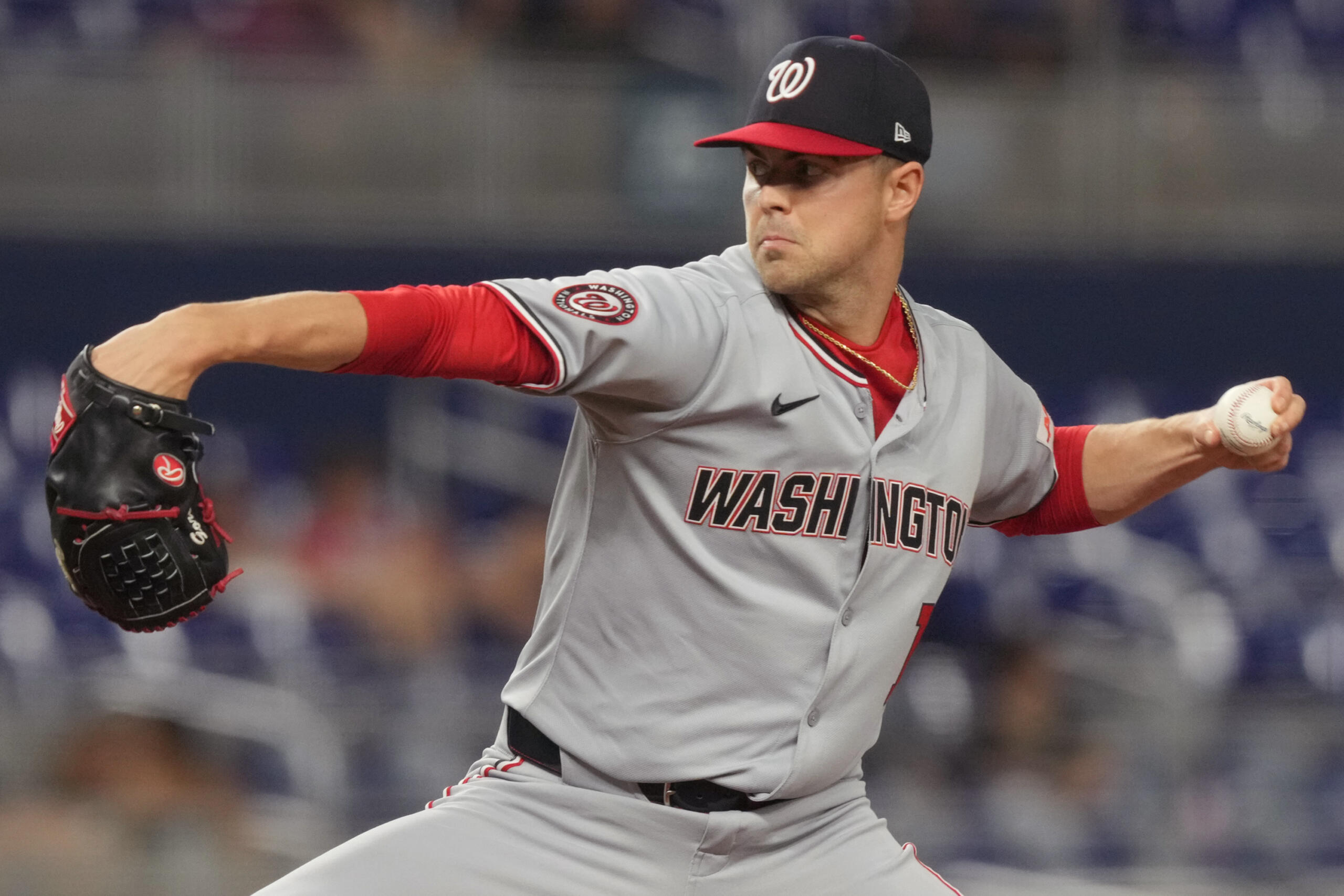
This trade is a clear snapshot of two teams operating on different timelines — and one betting on talent.
The Texas Rangers acquired left-hander Mackenzie Gore from the Washington Nationals, sending five minor leaguers the other way. It’s a move that prioritizes high-end pitching ability for Texas while allowing Washington to add volume and depth to its farm system.
The Trade Details
Rangers receive:
LHP Mackenzie Gore
Nationals receive:
SS Gavin Fien (No. 2 prospect in the Rangers farm system, per MLB Pipeline)
RHP Alejandro Rosario (No. 6 in the Rangers farm system, per MLB Pipeline)
INF Devin Fitz-Gerald (No. 12 in the Rangers farm system, per MLB Pipeline)
OF Yeremy Cabrera (No. 16 in the Rangers farm system, per MLB Pipeline)
1B/OF Abimelec Ortiz (No. 18 in the Rangers farm system, per MLB Pipeline)
Why the Rangers Made This Move
Texas isn’t just adding innings. They’re adding ceiling.
Gore has long been viewed as one of the most talented left-handed arms in the game, with frontline stuff and the ability to miss bats at a high level. His fastball has real life, his breaking ball is a legitimate out pitch, and when he’s locked in, he looks every bit like a top-of-the-rotation starter.
Just as important, Gore is still controllable. He comes with two more seasons of team control, meaning the Rangers will have him for 2026 and 2027. That window matters. It gives Texas time to maximize his prime years without making a long-term commitment up front.
Rather than moving one untouchable prospect, the Rangers spread the cost across multiple tiers of their farm system. None of the five prospects rank inside MLB Pipeline’s Top 100, but together they represent real value — a price Texas was willing to pay to land a pitcher with this kind of upside.
Why the Nationals Said Yes
For Washington, this deal is about volume, control, and flexibility.
The Nationals turn one pitcher into five prospects ranked inside the Rangers’ top 18 by MLB Pipeline, adding talent across the infield, outfield, and pitching pipeline. Fien headlines the return, while the rest of the package gives Washington multiple developmental paths rather than relying on a single outcome.
It’s a return built for a team focused on building layers of talent over time.
The Bigger Picture
This trade isn’t about winning the transaction on paper the day it’s announced.
The Rangers are betting that Mackenzie Gore’s talent wins out — that his stuff translates into consistent top-end production over the next two seasons. The Nationals are betting that volume and depth give them more long-term answers.
It’s a risk on both sides. But it’s also a deal rooted in clarity, direction, and belief in what each organization values most right now.