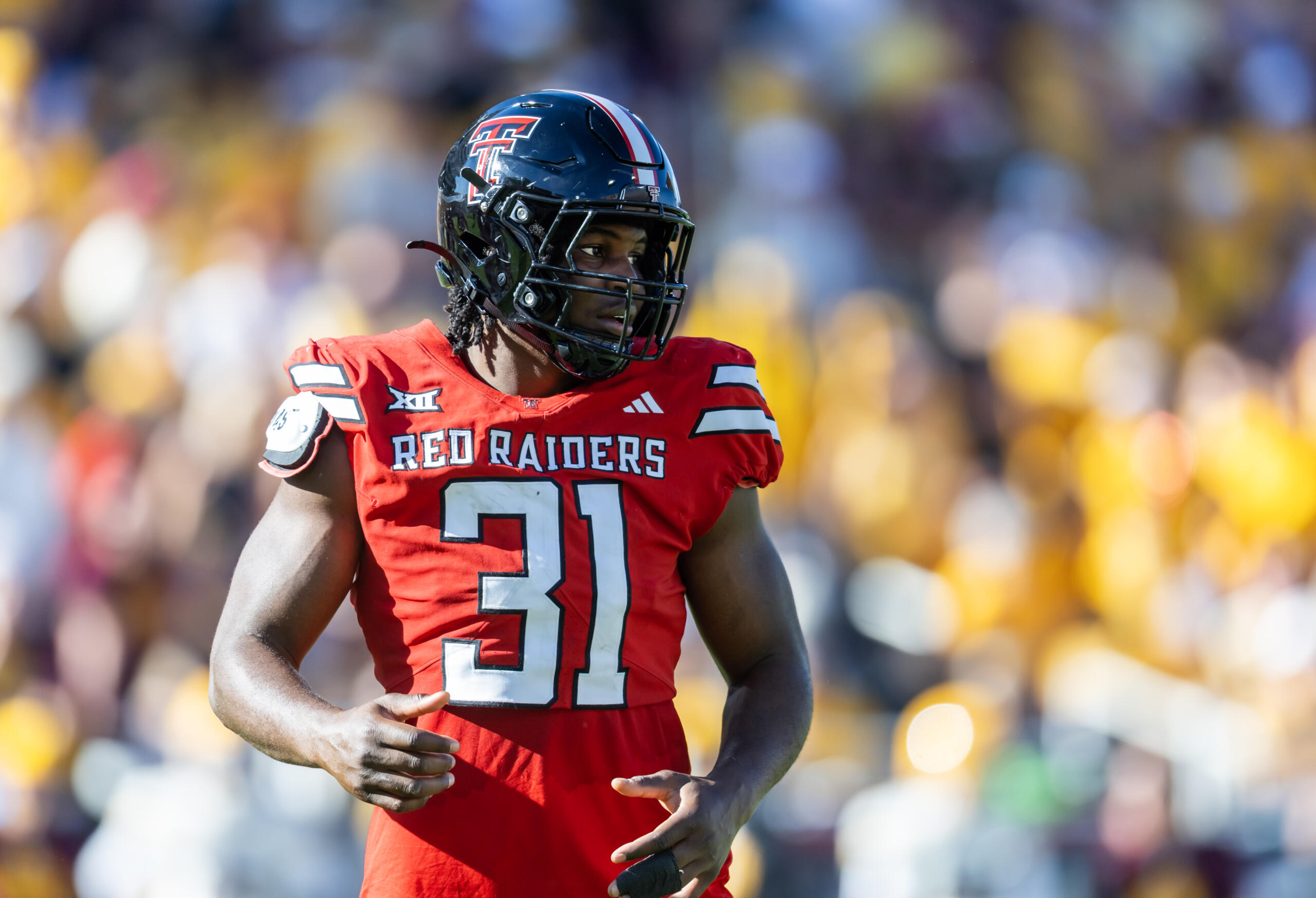
Texas Tech’s arrival on the College Football Playoff stage reflects a program trending upward through player development, defensive disruption and competitive depth. While the Red Raiders may not carry the same national profile as traditional powers, their 2026 NFL Draft class features several defenders and developmental pieces already drawing attention for how they impact games.
For Texas Tech, the playoff spotlight is about validation. These games provide a rare opportunity for players to prove their production and traits translate against elite competition. The Red Raiders’ 2026 prospects are defined by effort, versatility and edge play, with several defenders positioned to elevate their stock through postseason performance.
Edge Defenders: Pressure as the Identity
David Bailey, EDGE, headlines Texas Tech’s 2026 group and stands as the program’s most prominent draft prospect. Bailey brings explosive first-step quickness and natural bend off the edge, consistently stressing tackles with speed. He shows the ability to flatten to the quarterback and finish plays, traits that remain highly valued at the next level.
In playoff games, edge rushers are judged by their ability to affect timing even when sacks do not come. Bailey’s motor and closing speed allow him to influence passing lanes and force hurried decisions. Continued refinement in counters and hand usage would push him firmly into early-round consideration, but his disruptive baseline already stands out.
Romello Height, EDGE, complements Bailey with length and power. Height flashes the ability to convert speed to strength, collapsing pockets and setting firm edges against the run. While his production can come in waves, playoff football emphasizes consistency snap to snap. Height’s physical profile gives him a chance to thrive in that environment, particularly when offenses are forced into predictable passing situations.
Linebacker: Range and Readability
Jacob Rodriguez, LB, anchors the second level for Texas Tech. Rodriguez plays with awareness and range, diagnosing run schemes quickly and staying active in pursuit. He shows comfort working laterally and has enough burst to close gaps when plays break down.
Playoff offenses challenge linebackers with tempo and spacing concepts. Rodriguez’s discipline and ability to stay square matter as much as his tackling. His continued growth in coverage recognition will shape his long-term draft outlook, but his motor and instincts provide a solid foundation.
Defensive Interior: Rotation and Strength
Skyler Gill-Howard, DI, provides interior presence with strength and effort. Gill-Howard plays with leverage and power, anchoring against the run and occupying blockers. While he may not generate gaudy pass-rush numbers, his value comes through disruption and reliability.
Lee Hunter, DI, adds depth and physicality to the interior rotation. Hunter brings size and raw strength, holding ground against double teams and wearing down offensive lines. In playoff settings, interior defenders often earn evaluations based on how well they control space rather than statistics, and Hunter’s role fits that mold.
Wide Receiver: Emerging Options
Caleb Douglas, WR, serves as a physical receiving option for Texas Tech. Douglas uses his frame well, competes at the catch point and provides a dependable target on intermediate routes. In playoff games, receivers must win contested situations, and Douglas’ willingness to play through contact becomes valuable.
Reggie Virgil, WR, adds speed and vertical ability. Virgil stretches coverage and forces defensive backs to respect his deep threat potential. Even when targets are limited, his presence influences defensive structure. Continued refinement in route detail will determine how far his draft stock climbs.
Offensive Line: Developmental Pieces
Davion Carter, G, represents Texas Tech’s interior offensive line presence in the 2026 class. Carter plays with toughness and balance, anchoring against power rushers and maintaining leverage in the run game. Guards are often evaluated on consistency, and playoff reps against elite interior defenders provide valuable context.
Hunter Zambrano, T, brings size and length on the edge. Zambrano remains a developmental tackle, but postseason exposure against high-level pass rushers accelerates growth. His footwork and hand placement will be tested heavily, making every snap instructive for evaluators.
Quarterback: Experience Under Pressure
Behren Morton, QB, rounds out Texas Tech’s 2026 draft list. Morton brings experience, competitiveness and arm talent to the position. While his projection may remain fluid, playoff environments reveal how quarterbacks process speed, handle pressure and manage critical moments.
NFL evaluators watch how quarterbacks respond when protections break down and reads compress. Morton’s decision-making and composure in those moments matter as much as raw production.
Why the Playoff Matters for Texas Tech
For Texas Tech, the College Football Playoff provides exposure that few regular-season games can match. Every snap comes against elite talent. Every assignment carries consequence. For a roster built on effort, edge play and defensive aggression, that environment amplifies both strengths and weaknesses.
Bailey and Height have a chance to validate their pass-rushing impact against top-tier offensive lines. Rodriguez and the interior defenders are tested by tempo and physicality. Offensive players face tighter coverage and faster pressure.
The Red Raiders’ 2026 prospects may not dominate early draft boards by volume, but strong playoff performances can accelerate conversations quickly. For Texas Tech, this postseason is not just a breakthrough moment for the program. It is a proving ground for players looking to carry their development onto the NFL stage.