Ohio State’s College Football Playoff run serves a dual purpose every season. The Buckeyes chase championships, but the postseason also functions as an early evaluation stage for future NFL talent. This year is no different. Ohio State enters the playoff with a deep group of underclassmen who already factor into the 2026 NFL Draft conversation, many of them playing meaningful roles against elite competition.
Evaluating those prospects by position offers a clearer picture of how Ohio State’s present success connects to its future at the professional level. From a star safety anchoring the defense to developing linemen in the trenches, the Buckeyes’ next wave is already on display.
Secondary: The Backbone of the Defense
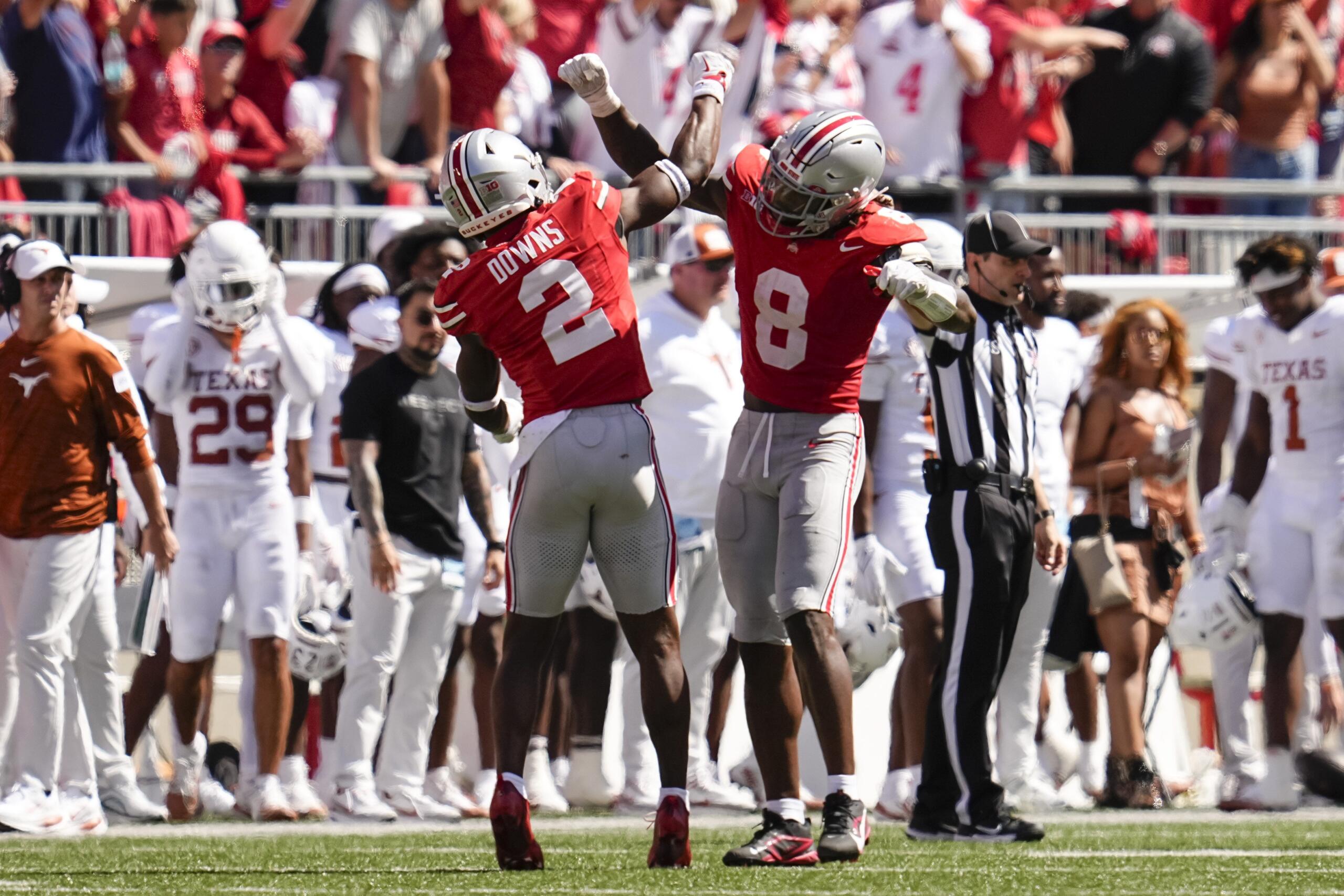
Caleb Downs, S, remains the centerpiece of Ohio State’s 2026 class. Downs plays with rare awareness for an underclassman, diagnosing route concepts quickly and closing space before quarterbacks can adjust. His range allows the Buckeyes to disguise coverages and rotate late, a critical advantage in playoff games where timing is everything.
Downs’ value extends beyond coverage. He tackles with control, supports the run game and communicates pre-snap adjustments with ease. In high-pressure matchups, offenses often try to stress safeties with motion and play-action. Downs consistently stays disciplined, limiting explosive plays and forcing offenses to settle.
Davison Igbinosun, CB, brings physicality on the perimeter. He challenges receivers at the line of scrimmage and competes aggressively at the catch point. Playoff football often becomes a test of toughness, and Igbinosun’s willingness to press and tackle adds an edge to the secondary.
Jermaine Mathews Jr., CB, continues to develop within a deep rotation. Mathews shows fluid movement skills and growing awareness in zone coverage. The playoff environment accelerates that growth, forcing young corners to process quickly against top-level receivers.
Linebackers: Range, Versatility and Pressure Ability
Arvell Reese, LB, stands out as one of the more intriguing second-level prospects on the roster. Reese brings length and athleticism that allow him to cover ground sideline to sideline, a trait Ohio State values in space-heavy defensive schemes. He moves well laterally, stays balanced in coverage and closes quickly when plays develop in front of him.
Reese also adds value as a developing pass rusher. When deployed on delayed blitzes or interior pressures, he shows a quick first step and enough burst to stress protection schemes. He accelerates through gaps rather than drifting, forcing quarterbacks to speed up decisions. While his hand usage and timing continue to evolve, his ability to generate pressure without lining up full time on the edge enhances his long-term projection. In playoff games, where defenses rely on disguise and simulated pressure, Reese’s pass-rushing ability becomes another way Ohio State disrupts rhythm offenses.
Sonny Styles, LB, offers a hybrid skill set built for modern defenses. Styles plays with urgency and physicality, attacking downhill against the run while remaining comfortable in space. His experience in multiple roles allows Ohio State to adjust matchups without substituting, an advantage in postseason play where tempo can dictate outcomes.
Defensive Line and Edge: Depth in the Trenches
Kayden McDonald, DI, provides power and stability inside. McDonald’s ability to anchor against double teams and control interior gaps does not always show up statistically, but it plays a critical role in playoff football, where winning first down often sets the tone.
Kenyatta Jackson Jr., EDGE, brings length and explosiveness off the edge. Jackson flashes the burst to threaten tackles vertically and the closing speed to finish plays. Consistency remains the focus, but playoff reps against elite offensive linemen offer valuable developmental snaps.
Caden Curry, EDGE, adds rotational depth with upside. Curry plays with effort and physicality, setting the edge against the run while continuing to refine his pass-rush approach. Postseason exposure often accelerates growth for developmental rushers like him.
Wide Receiver: Precision Over Flash
Carnell Tate, WR, remains Ohio State’s most polished 2026 offensive skill prospect. Tate wins with route discipline, body control and dependable hands. He creates separation through technique and timing rather than raw speed, a skill set that holds up when coverage tightens.
In playoff games, quarterbacks trust receivers who run precise routes and finish catches in traffic. Tate fits that profile. He also contributes as a blocker, adding value beyond the stat sheet and reinforcing his reputation as a complete receiver.
Tight End: Mismatch Potential in Development
Max Klare, TE, offers long-term upside as a size-speed mismatch. Klare continues to refine his role as both a pass catcher and in-line blocker. The playoff stage tests tight ends in protection and route discipline, providing valuable tape as his game matures.
Offensive Line: Building Blocks Up Front
Austin Siereveld, T, brings size and strength that evaluators covet at the tackle position. Playoff defenses test tackles with stunts, simulated pressure and speed-to-power rushers, making these snaps especially meaningful for long-term evaluation.
Ethan Onianwa, G, continues to develop on the interior. Guards often earn attention through consistency rather than flash, and Onianwa’s ability to anchor, communicate protections and handle power rushers matters in postseason football, where interior pressure can disrupt entire game plans.
Running Back: Power and Situational Value
CJ Donaldson, HB, adds physicality to the backfield. Donaldson runs with strength and finishes forward, traits that become valuable in tight playoff games. Evaluators also watch how backs handle pass protection and situational football, areas where reliability often separates roles at the next level.
Why the Playoff Matters
The College Football Playoff compresses evaluation into a handful of high-stakes games. Defensive backs face quarterbacks who process coverage quickly. Linebackers defend space and pressure passers. Linemen manage complex fronts. Skill players operate with minimal margin for error.
Ohio State’s 2026 prospects benefit from a system that mirrors NFL demands. Communication, versatility and discipline remain non-negotiable. As the Buckeyes pursue another title, this group quietly builds the foundation for the next draft cycle, reinforcing Ohio State’s reputation as one of college football’s most consistent pipelines to the NFL.